
Ask three concrete contractors about rebar vs wire mesh and you may get three answers. Each type of reinforcement does a different job, and the right choice depends on the slab, the load, and the soil. This guide explains how rebar, welded wire mesh, and fiber work so homeowners, builders, and general contractors know what they’re paying for.
Need a slab spec for your project? Talk to CC Concrete LLC about your reinforcement plan →
What reinforcement actually does
Concrete is very strong in compression and weak in tension. Reinforcement doesn’t stop concrete from cracking — it holds the pieces together when it does, so a crack stays tight instead of opening up and letting one side drop. Control joints decide where cracks happen; reinforcement decides how they behave.
That’s why the question isn’t only which reinforcement is strongest. It’s which one keeps this particular slab, on this soil and under this load, level and tight for as long as possible. A thin garden path and a truck apron need very different answers.
Rebar, wire mesh, and fiber compared
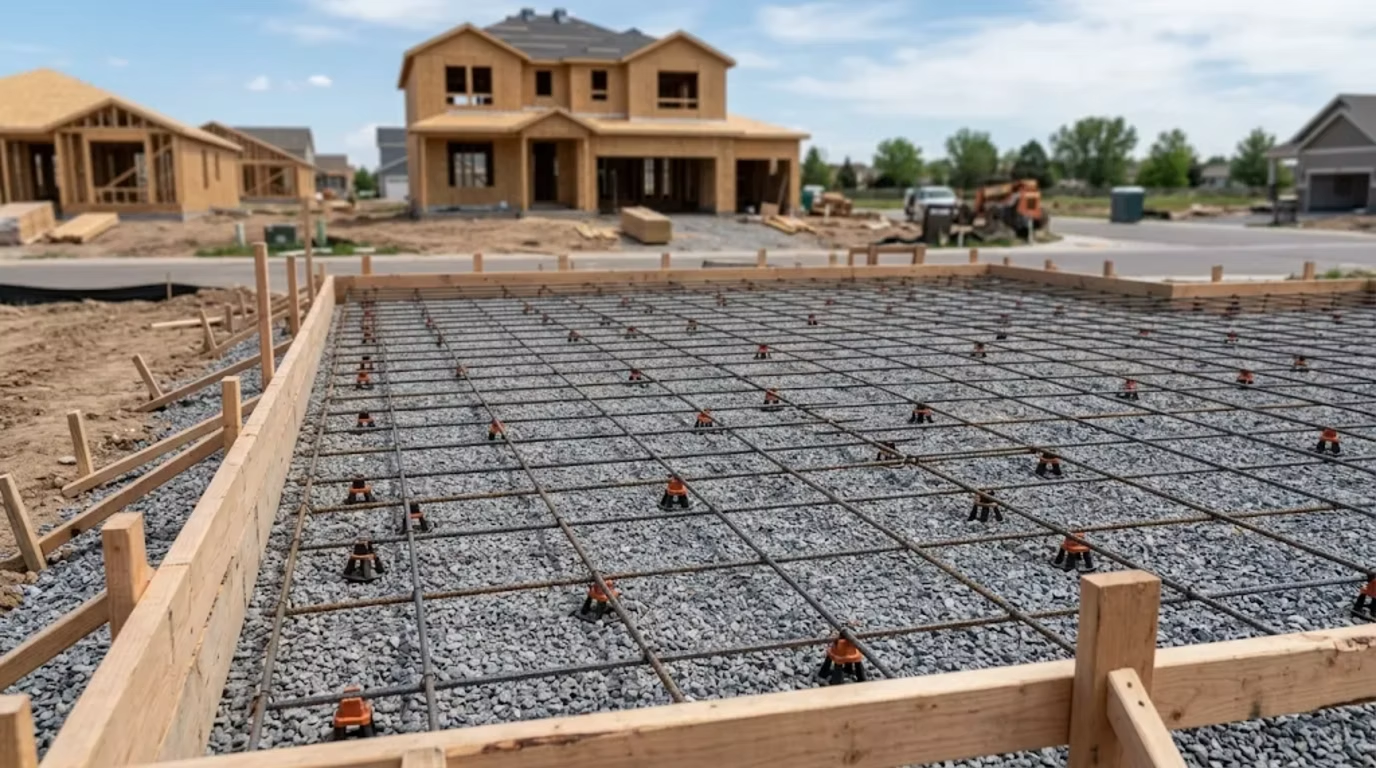
- Rebar: Steel bars tied in a grid and set on chairs so they sit in the middle of the slab. The strongest option for heavy loads, thickened edges, and structural elements like stairs and footings.
- Welded wire mesh: A steel grid in sheets or rolls. Lighter than rebar and works well in standard slabs, as long as it’s lifted into position and not left on the ground during the pour.
- Fiber: Synthetic or steel fibers mixed into the concrete. Helps control early shrinkage cracking throughout the slab, but it doesn’t replace rebar where structural strength is needed.
- Combinations: Many slabs use fiber with rebar or mesh — fiber for surface cracking, steel for holding the slab together.
Cost follows the same order. Rebar takes the most material and labor to place, mesh is quicker, and fiber adds cost to the concrete itself but saves placing time. The cheapest option on paper is not always the best value once callbacks and repairs are counted.
Which slabs need which
Driveways carry vehicles and see the most movement, so rebar is common. Patios and walkways often do well with mesh or rebar depending on soil. Garage floors, shop slabs, and equipment pads usually call for rebar and a thicker section. For residential pricing context, see our Denver concrete cost guide.
On commercial and builder jobs, the engineer’s drawings set the reinforcement. Our job is to place it exactly as specified — correct size, spacing, cover, and support — so inspections pass the first time.
Placement matters as much as the material
Reinforcement only works where it sits in the slab. Steel lying on the dirt does almost nothing. We set rebar and mesh on chairs, keep proper cover from the surface, and pair it with a compacted base, as covered in our guide to quality flatwork.
General contractors who need a flatwork sub that places reinforcement to spec can see how we work on our contractor services page.
Ask any contractor how the steel will be supported during the pour and what cover they hold from the top and bottom of the slab. A clear answer is a good sign that reinforcement will end up where it belongs.
Frequently asked questions about slab reinforcement
Is fiber mesh enough for a driveway?
Fiber helps with shrinkage cracks, but most Denver driveways benefit from steel reinforcement as well because of soil movement and vehicle loads.
Does rebar stop concrete from cracking?
No. Concrete still cracks; rebar keeps cracks tight and the slab level. Control joints guide where cracks form.
Why is it important to lift the mesh during the pour?
Mesh left on the ground ends up at the bottom of the slab where it can’t do its job. It should sit roughly in the middle of the slab.
Can you follow an engineer’s reinforcement spec?
Yes. On builder and commercial work we place reinforcement per the drawings and coordinate with inspectors.
Reinforced concrete done to spec
For over 14 years, CC Concrete LLC has poured reinforced driveways, patios, garage and shop slabs across Denver, Thornton, Erie, Brighton, Broomfield, Westminster, Arvada, and surrounding communities, for homeowners and for builders who need a reliable flatwork sub.
- Licensed and insured in Colorado since 2011, led by founder Cesar
- 4.9★ average from 82 Google reviews
- Free on-site estimates; written quotes include demolition and haul-away
- Air-entrained concrete mix for Denver’s freeze-thaw conditions
- Rebar and mesh set on chairs at the right depth
- Work to engineer drawings on builder jobs
The right steel in the right place
Rebar, mesh, and fiber each have a role. The best slab uses the right one for the load and places it correctly — that’s what keeps concrete level for decades. Request an estimate →